Bike share is not working in North Minneapolis

In the two meetings I have had recently with Nice Ride (the Minneapolis bike share program) it has become clear to me that the current U.S. model for bike share is not succeeding in lower-income communities at the rate hoped for by bicycle advocates. The reasons for this are layered, including low-density neighborhoods and the current concept of bike share just not solving the transportation problems of certain residents.

Both the executive director and outreach coordinator are very open and honest about why Nice Ride is not hugely successful in North Minneapolis, despite its high profile and positive reputation. As one often skeptical of mainstream bicycle planning, I was pleasantly surprised by all the steps they took to integrate Nice Ride into neighborhoods with a lack of already existing “bike culture.” Nice Ride remains committed to serving North Minneapolis…including in new and exciting ways.

The people at Nice Ride are very open to hearing ideas that would reshape what Nice Ride looks like in North Minneapolis. Like, forget the green bikes and stations. What else can we do?

So you are reading that correctly: they actually WANT ideas. They do not have a plan. But they have funding and bicycles.

Because this is an anomaly in the bike world, I hope this news gets around fast. Nice Ride has specifically requested ideas from bicycle advocates.

Perhaps someone out there has a vision of how Nice Ride can bring bikes to North in a way that would actively serve the community.

You may comment here or contact Nice Ride directly: volunteer@niceride.org

[[For background on the North side’s relationship with Nice Ride, please see this local NPR article]]

Where is the invisible cyclist?

The writers behind the Invisible Cyclist blog, Julian Agyeman and Steve Zavestoski, posted a literature review of popular press and academic musings about bikes and transportation equity.

You can check it out here  (full disclosure: I am cited)

Although the collection of new literature on the topic is helpful to anyone interested in biking and gentrification//equity//sustainability, it also suggests that advocates need to shift focus. Our voices have been heard through community meetings, dialogue with other cyclists, and  discussions with our neighbors. It appears that less and less people scoff when you combine bikes with the concepts of gentrificationclassism, or racism. I have also had multiple undergraduate students contact me to discuss their research on this very subject.

We have certainly made progress, but we still have a lot of work to do. For example, I am still disappointed in the lack of data collected on people of color bicyclists–from the U.S. Census to local bike advocate organizations. I hope to work with local organizations to experiment with common data collections sites such as Bike Counts and focus groups to see where we can improve research.

All of this to say that this is an exciting time where we can shift our focus to some strategic planning to make sure equity is a part of all bicycle advocacy discussions.

Helmets, M.

Interview with Da Rich Kidzz

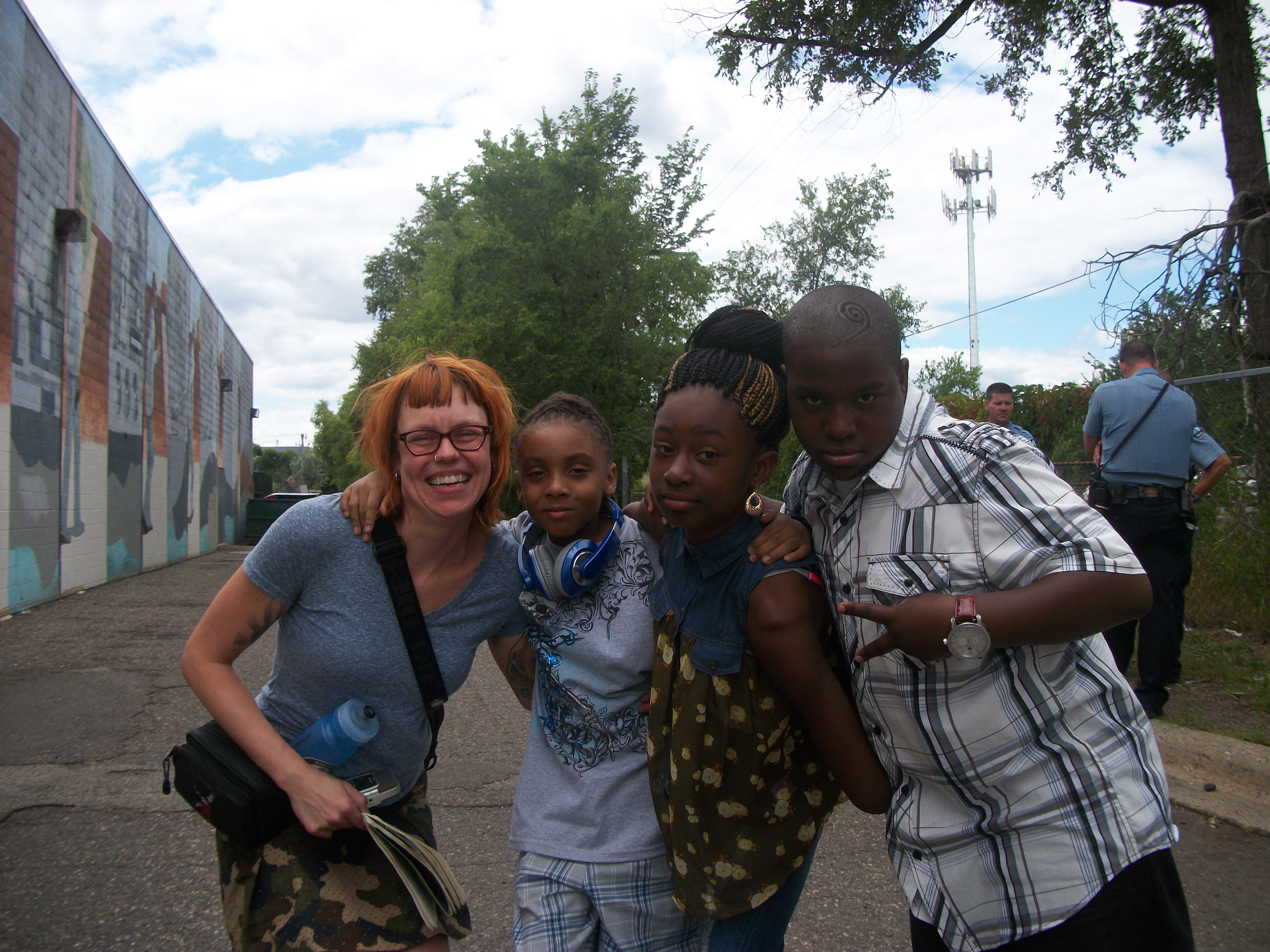
This summer, I brag-posted about meeting Da Rich Kidzz (FKA Y.N.RichKids). I was able to chat with G-6, Lady J, and Ben-10. Here is the transcript of our conversation. (Also I lack all ability to interview people under the age of 18, as illustrated here)

100_3085

Melody: Who came up with the idea for “My Bike”?:

G-6: We all came up with the idea at the Beats and Rhymes program at the YMCA

Melody: Do you all ride bikes?

Group: Yes

Melody: everyday?

G-6: Yes.

Ben-on-10: Not every day.

Lady J: I do!

Melody: Do you ride to school or your friend’s house?

Lady J: I just ride back and forth at home.

Melody: You all live in North [Minneapolis] right?

Group: Yes

Melody: Ok, so do people your age think biking is cool?

G-6: I don’t know how other people feel about riding bikes but I know the friends I hang out with like to ride bikes.

Melody: So no one makes fun of you?

Continue reading

Zombies, transportation, and racism: A night with a camera and the light rail

Zombies, transportation, and racism: A night with a camera and the light rail

Late into the evening on October 12, I took two documentary filmmakers, from either coast, to the local Zombie Pub Crawl. The filmmakers were in town to do preliminary research on the Twin Cities and the theme of “access and opportunity” as it pertains to transportation issues. I figured, at the very least, it would be fun for them to film hundreds of young adults passionately acting like zombies as they roamed Cedar Ave. in the Cedar-Riverside neighborhood.

In reflecting back upon the evening I find myself caught up in a volatile mixture of emotions. In pride, I marched the filmmakers through Minneapolis to reveal the public’s desire for better transportation. Along the way, though, I was jolted out of love for my city as young adults smattered with sweet-smelling fake blood revealed the true racism that remains in this city.

LTR >> Cedar-Riverside

In Minneapolis one of the best times to ride the light rail is during public events where driving is a rather costly idea. It is one of the few times where people in this city who are usually glued to their vehicles will hop onto the trains and timidly jam themselves up against strangers. The Zombie Pub Crawl is no exception.

We hopped on the light rail downtown, a few stops from the Crawl. The train was mostly empty and I had plenty of time and space to assist a man in showing him how to get to the airport. As we approached the Metrodome (where our NFL team plays) I turned to the filmmakers to point out the stadium, but was suddenly confronted with zombies. They pounded on the train doors and filed in screaming BRAINS! I nervously held onto my bike as it swayed in the vertical bike rack and watched as my compatriot was slowly pushed up against the window, drunken zombies surrounding him. Meanwhile, the other filmmaker had gotten it all on camera: empty to painfully full. We only had one stop to go. Continue reading

Dark to Dawn: A reflection

From 9 p.m. on August 24 to 6 a.m. on August 25, I participated in an amazing bicycle ride, simply titled “Dark to Dawn: A Bicycling Journey.”

“Amazing” is perhaps an understatement. To commemorate the 50th anniversary of the March on Washington, four local bicycle organizations organized a ride around Minneapolis and St. Paul, to highlight places where African Americans once thrived, continue to thrive, were terrorized by white populations, and/or fought back against racism and classism in the name of civil rights.  The ride was creative, sobering, educational, fun, humbling and joyful. I could not have asked for a better bicycle ride.

Our first stop: First Black "fueling station" in South Minneapolis

Our first stop: First Black “fueling station” in South Minneapolis

Members of the Major Taylor Bicycling Club of Minnesota led a group of 35 cyclists through the dark streets for 9 hours. Throughout the planned route, members of the club stopped us and explained the importance of where we were. As someone interested in neighborhoods, communities, and how space means different things to different people, I found every stop full of fascinating information. Sometimes, the members had personal connections to the stops and explained their history to the space. Louis Moore showed us his house and told his story about being the first Black family to move into the neighborhood. Seitu Jones showed us a lot of the public art projects he has done throughout the cities. Most recently he did some excellent artwork on the just-opened Van White Bridge. On the Bassett’s Creek Trail he constructed a “Fair Housing” piece built into a bridge over the water. In fact, he has done so much artwork throughout Minneapolis that one rider exclaimed, “are there any other artists in Minneapolis?” Seitu’s commitment to political, public art is commendable and I am so grateful to be given the opportunity to meet him and see (only some of) his work.

Seitu's stained glass work is in this church, but it was too dark to see.

Seitu’s stained glass work is in this church, but it was too dark to see.

I rode many miles next to Anthony Taylor, a member of Major Taylor (and co-host of a great show, “Day One,” on KMOJ) as we discussed the necessity in seeing the cities not just as they are now but what they once contained. For example, the ride took us to Heritage Park apartments in North Minneapolis—a wide swath of new, modern apartment complexes. But what stood there before was Minneapolis’s largest housing project. Another stop landed us at an empty lot on 38th St & 4th Ave. South, where ride leaders spoke to us about how the corridor used to be a booming Black business district. During this stop, Anthony brought up the issue of how gentrification impacts Black communities and had us start to think through how bicycle amenities may have a serious role in the gentrification process. Anthony and I rode away from the stop together engaging in a thoughtful discussion about the role of food co-ops in poor neighborhoods and our country’s economic relationship to healthy food.

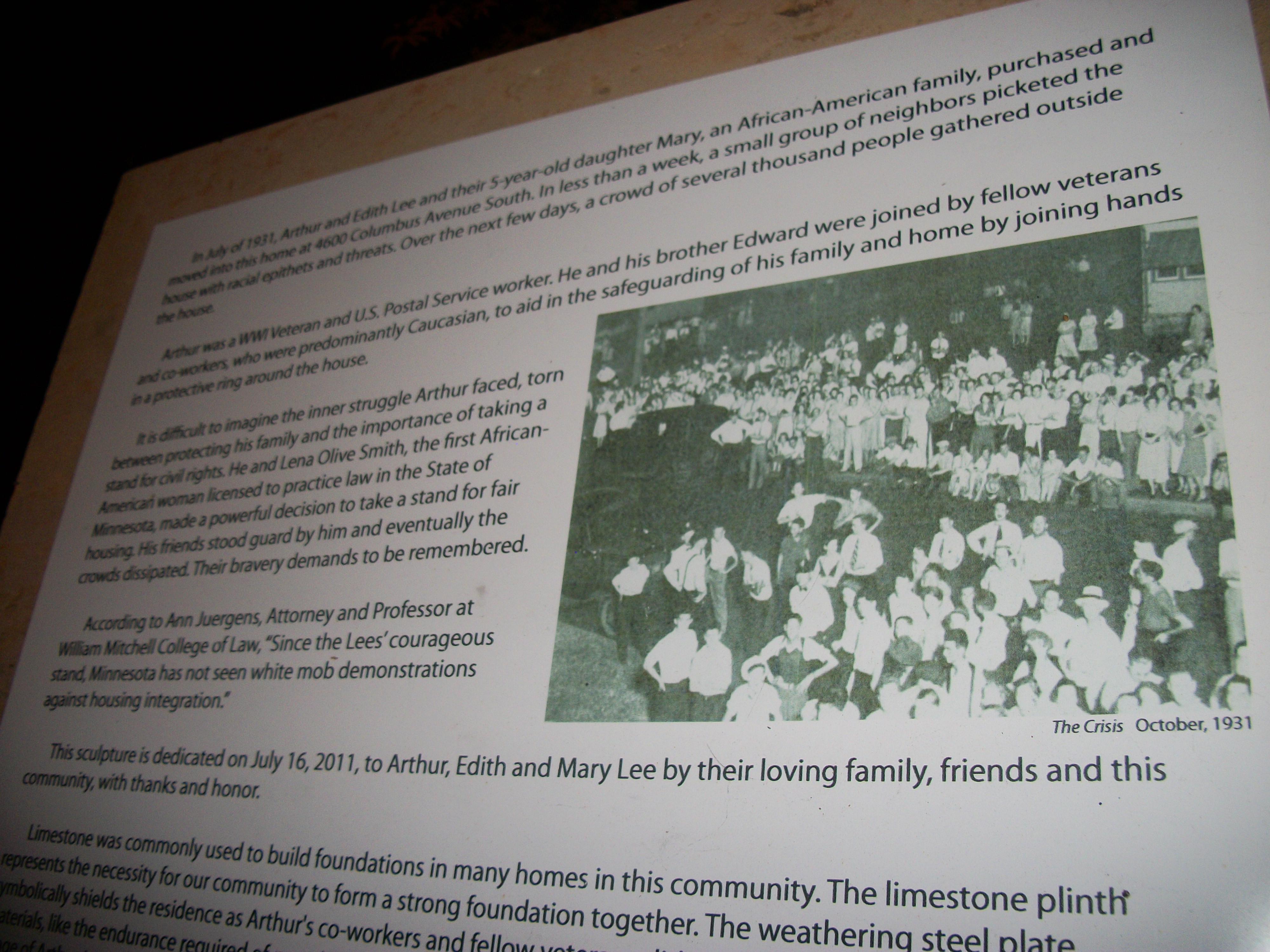
The Lee House

The Lee House

The Lee House's placard detailing the riots that ensued when the Lee family moved in, in the 1910s.

The Lee House’s placard detailing the riots that ensued when the Lee family moved in, in the 1910s.

A full list of stops is available at the end of this post.

During other times, I rode along with other bicyclists, chit chatting about our current projects in life and future goals. Everyone was genuinely interested in each other, why they chose to partake in this ride, and how all of how own community activism melds together.  As a white woman who has participated in endless bicycle events put on by white people, it was clear from the beginning how different this event would be. I actually felt comfortable and welcomed during the entire ride. Men often find a way to make anything a competition and yet somehow the “slow ride” energy maintained itself the entire time. The only time the group broke up momentarily was at stop lights and at the end of the ride when people could not wait to get to (the fanciest post-bike ride) breakfast and high tailed it back to the Cultural Wellness Center in Minneapolis from downtown St. Paul (a 15 miles ride!).

Art inside the Colin Powell Academy

Art inside the Colin Powell Academy (Jesuit school)

To be blunt, it is no surprise that a ride organized largely by not white men (NWM) turned out to be welcoming to everyone. Walter, the ride’s official leader, mentioned to me at breakfast that the ride was majority women. White men were the very small minority on the ride. No one wonder I felt so comfortable. In the bicycle advocacy world so many people are concerned about how to get more NWM biking. Perhaps we can look to rides like Dark to Dawn and think through why this ride was as diverse as it was. Why did women feel comfortable doing something as crazy as riding overnight? (When, apparently, we are too scared to ride in the streets) Why were white men in the minority?

Members of Major Taylor Club at the Union Depot (our last stop)

Members of Major Taylor Club at the Union Depot (our last stop)

In closing, I cannot thank the organizers enough for such a fantastic ride. Being able to hang out with members of Major Taylor (the sweetest, coolest people ever—seriously) has gotten me to rethink what is going on in the bike world in Minneapolis. If you too would like to do some brain rewiring, I invite you to attend either of these events:

Bikes: They’re not just for white people. 

A talk with Louis Moore (one of the speakers during the ride)

9/10 at 5 p.m. @ T-Shoppe Bar, 4154 Fremont Ave. N.

Major Taylor Group Ride!

Every Wednesday at 6:30, meet at Freewheel on the Greenway (under 11th Ave S.)


A  list of stops on the Dark to Dawn ride:

South Minneapolis

Lee House 4600 S. Columbus

46 & 4th — Angelus Nursing Home

Kirks’s Mobile

Field Elementary School

38th & 4th Nicollet Old Black Business district including the Minneapolis Spokesman

29th & 4th — Colin Powell Academy

North Minneapolis

Plymouth Avenue, the only remaining storefront left after 1968 riot and white flight are

Homewood Studio and Plymouth Avenue Studio.

Heritage Park

Van White Blvd and Bridge

Fair Housing Overlook

Gertrude Brown Memorial

Phyliss Wheatley Center

St. Paul

State Capitol

Old Rondo

Jimmie Lee Rec Center

Sterling Club

Denzil Carty Park

St. Peter Claver,

MLK Center

Pilgrim Baptis,

Western Bank (Frank McGhee)

Union Depot — site of the new Red Cap Room

HELMETS, M.